Not a frog

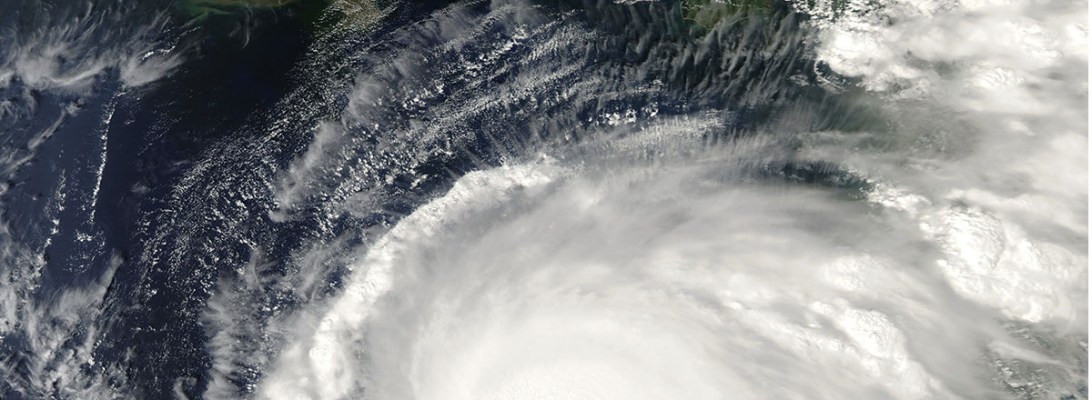
Image by M. Maggs from Pixabay

This story has been told so many times in my family that we all are numb to its horrors. There are many things of which I always had to be reminded, because I had no memory of it, such as me being pulled out of the pond by my hair because I was so heavy, in my waterlogged snowsuit and boots, that I could not be picked up, and that later, after resuscitation, my teeth were chattering so hard that I had bitten my tongue all up.

I don’t remember hearing my little brother’s screams as he stood on the slippery snow-covered edge of the slushy pond. He told me later that he was afraid that he would fall in, too. He was still clutching his icicle. My icicle had slipped out of my hands into the pond after I had stuck it in the deceptively smooth, white surface, hoping to discover that the pond had frozen over and that we could play on it like we had slipped and slid hilariously around on it last winter.

But for the record, for those of you that have never heard this story, I’m putting it here, hoping in the retelling that I might find some art in it. “Art is long and life is short, and success is very far off,” as Joseph Conrad once said.

Józef Teodor Konrad Korzeniowski, later “Joseph Conrad” was a Polish sea captain who did not learn English until he was in his twenties, and did not start writing until he was 35. He wrote prose like J.M.W. Turner painted seascapes. He wrote unparalleled descriptions of sea meeting sky, the solidarity of human experience, and of the darkness that can overwhelm the individual soul. He wrote “Heart of Darkness,” which was later made into the acclaimed Coppola 1979 Vietnam war film, “Apocalypse Now.”

The darkness I remember, but I do not remember feeling horror or cold as my waterlogged clothes pulled me under. I do remember watching in wonder as exotic tropical fish swam inquisitively around me, a vision conjured up by my brain as my oxygen ran out.

My icicle was beautiful and sparkly and longer than my brother’s icicle. The 2 longest icicles had been broken off the roof of my grandparents’ house and given to us by an adolescent neighbor boy that did odd jobs for my grandparents. I had held it up to the brilliant sky and admired the refractions and the sunlight trapped in it. It was a thing of power and beauty. I gave it a lick with my tongue. “Let’s check on the pond,” I said to my brother. The pond was down the hill, on the other side of the house.

I also remember reciting an “oral report” that I had carefully composed about this experience  several years later in elementary school (4th or 5th grade?). Our class was graded on the sophistication of the vocabulary words we used in these weekly reports. I used dramatic phrases like “as I slid down into the murky depths…,” as I bounced up and down nervously on the balls of my feet while synchronously bouncing the fingertips of both hands off each other. I’m sure my performance was hypnotic, but not for the right reasons.
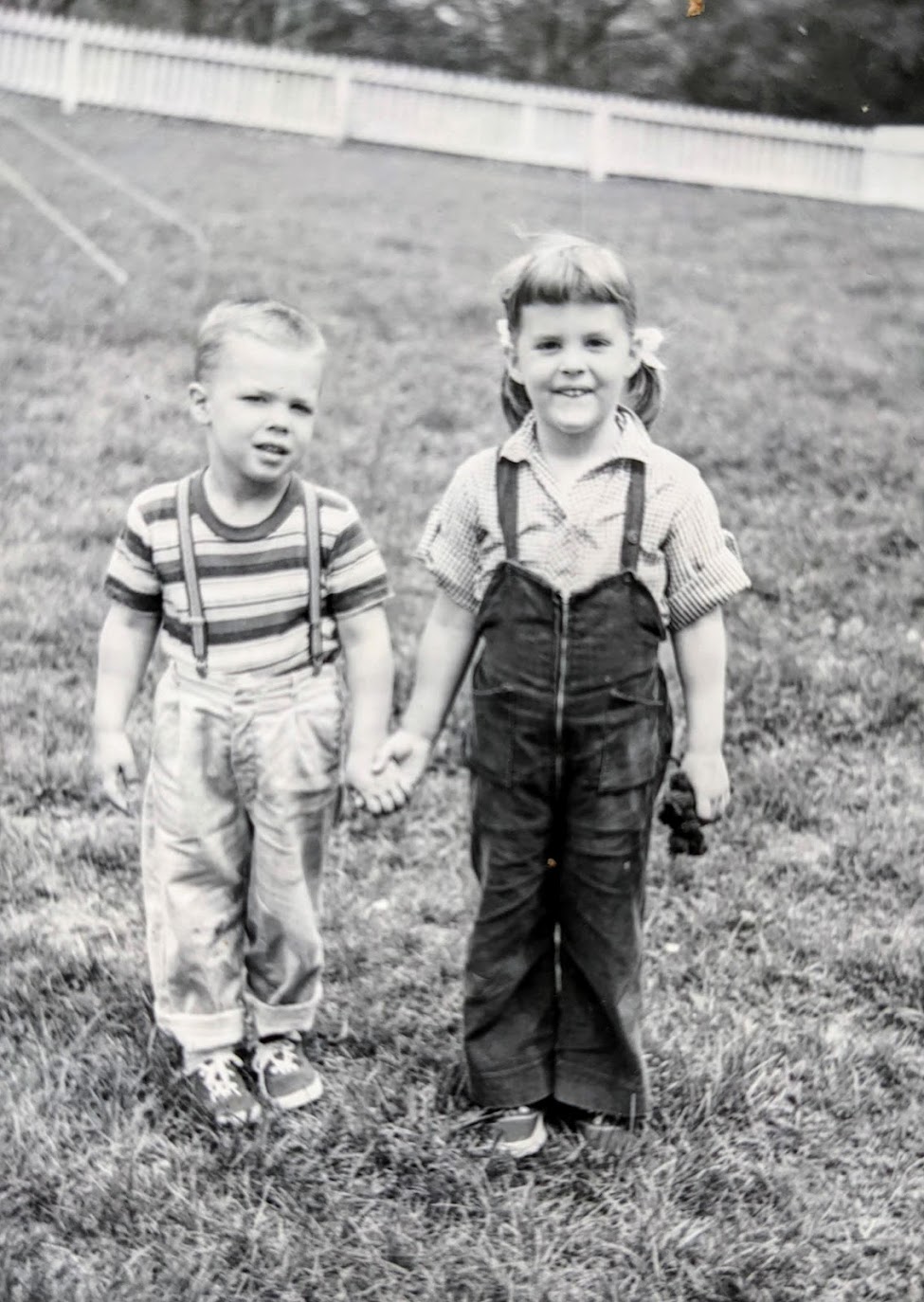
My brother and I the Spring following my drowning. Because of his screams, I was saved!

My brother and I had been sent down to my grandparents’ house from my parents’ house to fetch a can of beans. We all lived out in the country on an old estate, with no visible neighbors. Our mission was immediately forgotten upon the gift of the icicles. Thus armed, we turned towards the pond. Was it frozen over yet?

So I lay down in the snow on the edge of the pond, and stuck my icicle in the water. The slush curled back from the thrust, revealing for a moment the cold, brackish, dark water underneath. I smelled the cold, black water, my icicle slipped out of my glove, I made a grab for my beautiful icicle, then I slipped into the pond after it.

I came up for air once, trying in a level-headed way to swim towards my red-faced brother, whose screams I could not hear, then was pulled under and saw the fish. I was told later that my grandparents, drawn my brother’s hysterical sirens, came running out of the house in their bathrobes and fished me out, then my grandfather resuscitated me. I remember opening my eyes under a heap of quilts, seeing a blurry circle of worried faces around me. I was told to drink a glass of revolting, brandy-laced warm milk, or “the doctor will pump your stomach out.” My brother, 3 years old, was left outside, alone in the snow, just outside the door, while this was going on.

Decades later, the sensations remaining in my alligator brain from this experience are the shock and dismay of first sliding into that dank, unreflective water, then the jolt of regaining consciousness later. And the loss of my beautiful icicle.

It was an innocuous, very small, stagnant pond in which this drama occurred. No one has ever remarked on its beauty, for it has none, and it does not care. It quietly gurgles on to this day. Without memory or feeling or even art to it. Just frogs.
Image by johnnpas from Pixabay

Serious side

One of my favorite bosses once accused me of being a little “zany,” and at times I suppose I am, however one of the things on my serious side is choral music. I have loved singing with choirs since I was a kid. The feelings that are generated while standing shoulder to shoulder with singers on either side run very deep.

Dance does the same thing for me.

When I was a kid, my brother and I would make a big deal about making a hike up the ridge to visit the “springhouse” deep in the greenly moving, tall woods. I suppose this was our well, but not too clear on this. We’d pack a snack of raisins and candy or something to sustain us on our journey (it really wasn’t THAT far away). It was a small, decaying clapboard structure with a door held shut by a simple hook and eye.

When one lifted the hook and swung open the creaky door and peered inside (after the daddy long-legs scrambled over each other to get out of the way, clumsily and annoyed) over the ripply surface of the dark, bottomless water would puff a mysterious, woodsy, minty smell, cool air would caress your face, and you could hear a faint gurgling. We’d stare in, silently and reverently, for a couple minutes, then close the door, and, spiritually refreshed, make our way back down the ridge.

This springhouse experience is how I would describe my feeling of singing in choir. That gentle stirring of cool, dark, fresh, sweet water deep inside.

I also enjoy creating my own multi-harmonied improvisations which you can listen to here.

So I’m beginning an archive here to which I will add, from time to time, as they occur to me, some recordings of choral music that I love. Enjoy!

Beginning with “Sleep,” by Eric Whitacre.

“Let My Love Be Heard” by Jake Runestad

More to come.

Why I’m in North Carolina, or, Was the Evacuation Worse Than the Hurricane?

This is an email I composed immediately after the 2005 Hurricane Rita evacuation. I was exhausted. The evacuation was horrendously mismanaged. Some lost their lives on their arduous routes out of the city of Houston if they didn’t leave far enough in advance. Since Rita, which was not a direct hit, there’s been other hurricanes, most notably Ike (2008) and Harvey (2017), that have grievously impacted my former community.

Saturday, September 24, 2005

This is a “pre-positioned” email. In other words, I’m writing this before I am able to send it, as the house that is sheltering me is not wired for the internet. This is much like the relief forces that were “pre-positioned” (in the words of Houston Mayor Bill White and Texas Governor Rick Perry) to alleviate suffering post-Hurricane Rita. But for some reason, no politician in charge had the foresight to “pre-position” relief agencies along the evacuation routes taken by the 2.8 million that were asked to leave Galveston and Houston, and, like us, were forced to either drive continuously for 24 to 34 hours to reach safe destinations, or forced by the hundreds to stop at the side of the road in the 104 degree heat, out of gas or broken down, many seen with babies on their hips and small children and animals.

On the road to Palestine

Wednesday, September 21, 2005

We leave at 5 p.m. from Galveston to travel I-45 to my husband’s Aunt Ruth’s house in Palestine, TX. The sun sets. At 3 a.m. we had only gotten as far as FM 1960, a little north of downtown Houston. The bright streetlights bathe the congested freeway and service road with surreal yellow light, illuminating all manner of vehicles bumper to bumper as far as the eye can see, all inching their way out of town, all carrying their most valued possessions.

Earlier, we had passed a huge trailer transporting Arabian horses, and a pickup carrying birds in birdcages. We rarely go faster than 5 mph. My husband is driving our Toyota Tacoma truck with our computers and financial records and extra containers of gas, and I am driving our Camry with our 12-year-old son and two corgis. We are separated before we reach Beltway 8. He stops to call me from a Mobil station, as I am the only one with a cell phone.

It’s a bumpy ride, and we are still driving

2005 Hurricane Rita evacuation from Houston.
Public domain image.

Thursday, September 22, 2005

The sun rises again. We are still driving. A sharp pain cruises down my right leg. I haven’t taken my shoes off since I left home. We listen on the radio as, incredibly, Mayor Bill White is still urging people to leave town. But the contra-lane is not opened up till 3 p.m. By then, it’s too late for many people. The freeways and service roads are fatally choked with traffic.

It was surrealistic to witness such a scene, even more so to be a part of it. After 20 hours of driving and knowing the hurricane was gaining on us (the hurricane is moving 14 miles an hour; we are hardly moving at all), everyone starts falling asleep and bumping into each other. Someone in the middle lane bumps into the car in front. The front car doesn’t even acknowledge it. Later I bump into my husband’s truck in front of me. An hour later outside of Huntsville, someone bumps into me. We pull over to the side, there is no significant damage to my bumper – “I fell asleep…”, the other driver says – we shake hands and move on.

Two minutes later, my husband falls asleep and his radiator rams into the trailer-hitch of the pickup truck in front of him. The people of the rear-ended truck (who turn out to be Christian missionaries) load our stuff into their truck, our computers into the back of my car, and my son and our two corgis into their van, and, leaving our totaled little truck on the side of the road, our now 3-vehicle caravan continues onward to Palestine, TX.

We call Aunt Ruth and tell her we are almost there. We’ve been calling her every 4 hours or so and telling her this. We really believe that this has to break up soon.

We lose track of our child and dogs for 6 hours

The sun sets again. It becomes very hard to see. People are pulling off to the side of the road in droves to get some sleep. My car and the missionaries’ truck ahead of me become separated from the missionaries’ van containing my son and dogs (they were leading) and our cell phone service has shut down. The driver of the truck with my husband as a passenger pulls over; I pull over. The driver walks back to my car. I roll my window down. He asks, “Did you see the van? We’ve lost sight of the van!” So we head off towards Palestine again, hoping that we all know we are supposed to meet up there.

During the next six anxious hours on the dark road, my bloodshot eyes are riveted on the tail lights of the truck driven by a stranger with my husband as passenger, and worrying about the lost van with the other strangers carrying my son and dogs. I don’t even know their last names!

The adrenalin this fear produces keeps me awake until our cell phones connect in Palestine and we are finally reunited at Applebee’s and proceed on to Aunt Ruth’s house. We call her. She is awake.

We’re almost there, Aunt Ruth!

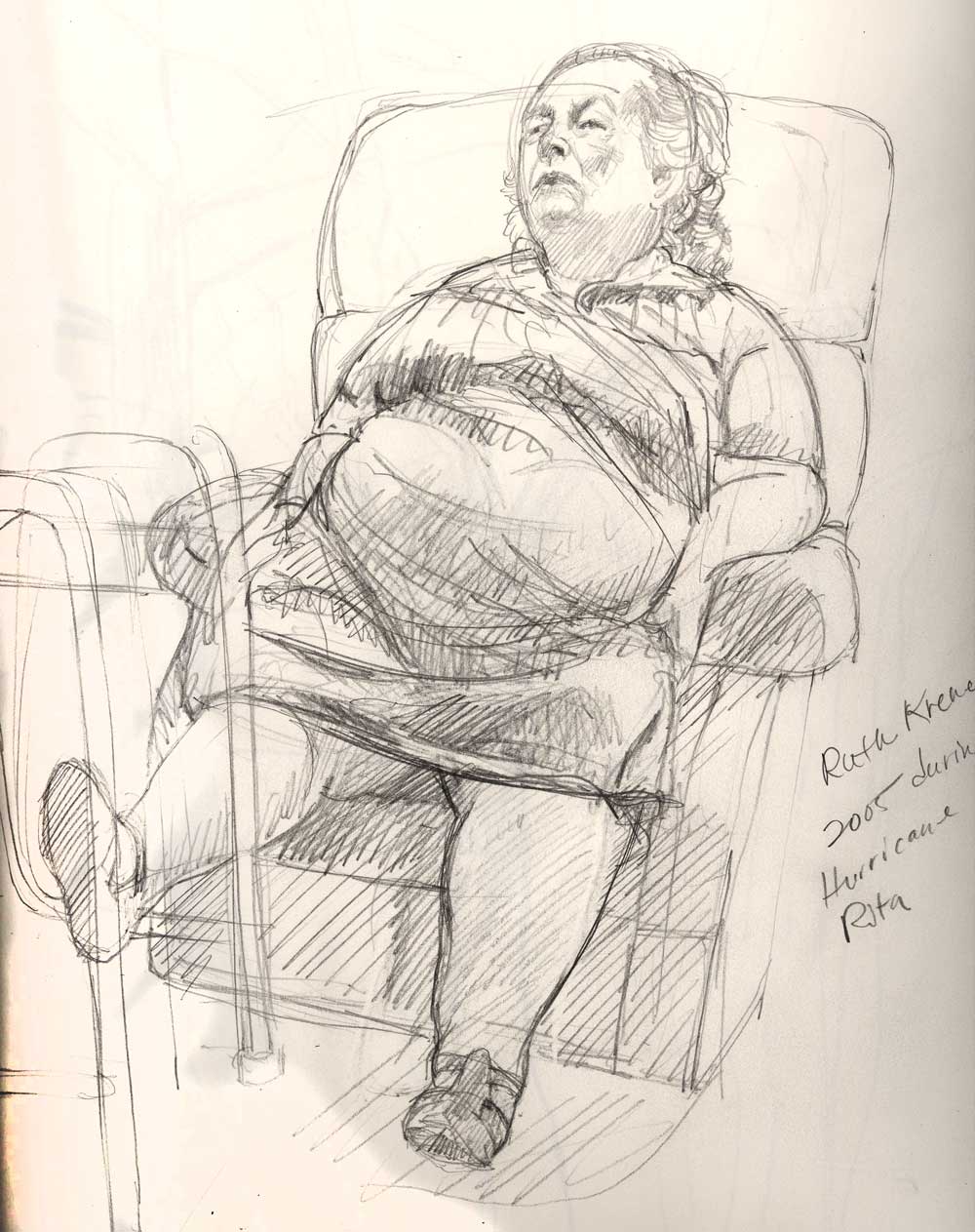
My husband’s Aunt Ruth. We stayed with her when Hurricane Rita tore through Texas.

Friday, September 23, 2005

Aunt Ruth has been waiting for us for two days, for the duration of a trip that normally would take about four or five hours. We had left at 5 p.m. on Wednesday, an hour before mandatory evacuation of Galveston Island was announced, already exhausted after spending all day strenuously boarding up our home and packing our valuables and hauling them out to the vehicles and upstairs. We arrive at Aunt Ruth’s at 12 midnight on Friday.

We thanked the strangers, who are now our friends, who gave us the lift, and they told us they would drive on to Tyler, TX, [which was hit by the storm on Saturday, the 24th]. We don’t know how to contact them (they have my business card), hopefully they will call us and let us know how they are doing. Palestine only had rain and some wind.

By the way, Aunt Ruth was quick to correct our pronunciation of “Palestine”. She said, ” ‘Pal-eh-STEEN’ is in Texas. ‘Pal-eh-STAHN’ is in the Middle East!”

Recovery

Saturday, September 24, 2005

We took two naps Friday, and two naps today. I’ve drank gallons of fluid to rehydrate. Yesterday night Aunt Ruth took us to eat at Applebee’s and we feasted on steaks, shrimp, potatoes and vegetables, the first sit-down meal we’ve had in three days.

From the parking lot, we could see the calm, lenticular clouds of the hurricane, quietly stacked like a pile of pancakes, belying its ferocity as it raged through Southeast Texas.

On our trip, we had only stopped briefly for two bathroom breaks. We were fortunate to find a convenience store that had remained open, so we stopped there on the way up, and on the way back. Many other stores were boarded up. We stopped at a Kroger, and the manager stood behind the locked glass door and shook his head as I pleaded entry. For two days, we had eaten only cereal and rolls my husband had made a few days before. I had been afraid to drink much because I knew there would be few, if any, bathrooms along the way. People relieved themselves in parking lots. I had carefully nursed a 2-liter Sprite for 31 hours. We kept thinking, just a little further, and we would arrive. We never dreamed that we would just be driving…and driving…and driving.

Yesterday morning, we microwaved pizza my husband had packed in the cooler, then slept most of the rest of the day. 

I have been unable to reach most of my friends by cell phone – I’m hoping I can find a hotspot somewhere in Palestine tomorrow so I can send this email!


Wednesday, September 28, 2005

One week later, we make it back home in 4 hours

I am sitting in the coolness of my home in Galveston. Our power is on, our water is drinkable. We have not had any damage, other than a chink in the fence and plant matter strewn everywhere. We left Palestine at 10 a.m. today and arrived in Galveston at 2:30 p.m. – a normal drive time. There were no hotspots in Palestine to use my laptop; there were laptops very considerately set up in Palestine Public Library for refugees’ use, so we were able to at least check our email and send short replies.

Our windows are still boarded up, and black plastic trash bags containing our most precious belongings clog up the house. A Bird-of-Paradise plant that my husband has had for years greeted us with it’s very first bloom! We are glad to be home. The corgis are glad to be home too. Our son is back on my husband’s computer playing computer games. He returns to school tomorrow, and soccer practice tomorrow night.

What infrastructure?

We are glad to have a home to return to, but we are unhappy with the lack of evacuation preparedness exhibited by authorities. We are also unhappy that we were charged $500 for a routine tow and storage of my husband’s truck during the hurricane, but very grateful to the others who stepped forward to help. Our hearts go out to those who now have no home, or who became ill during that long drive, or who lost family members during this extended brutal summer.

We are also glad and grateful to have family, friends and associates like you all to return to. So many have lost their entire communities. Our relationships make our work and recreation meaningful. We are glad you are there.

Wendy Aldwyn

Snow wonder

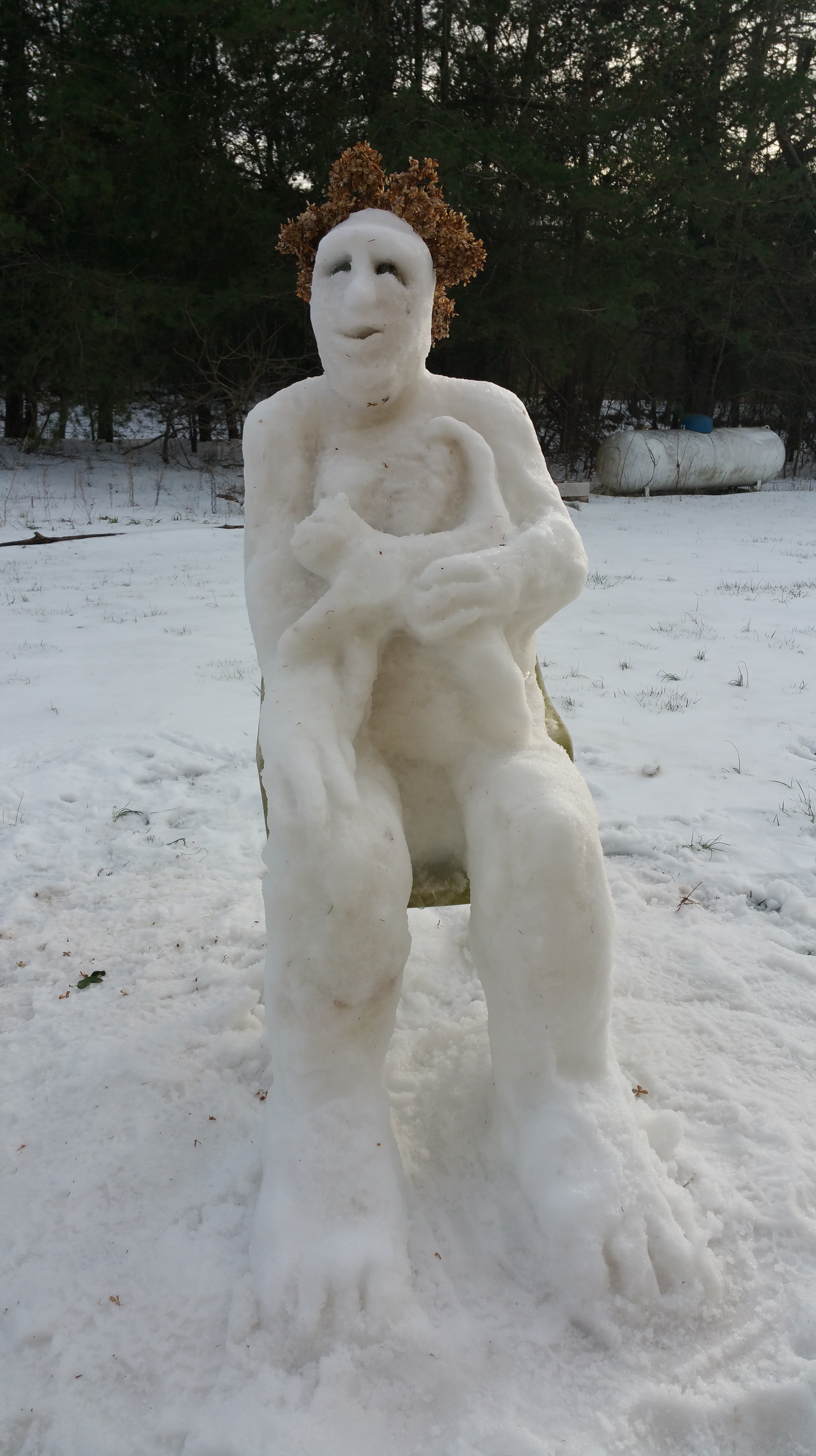
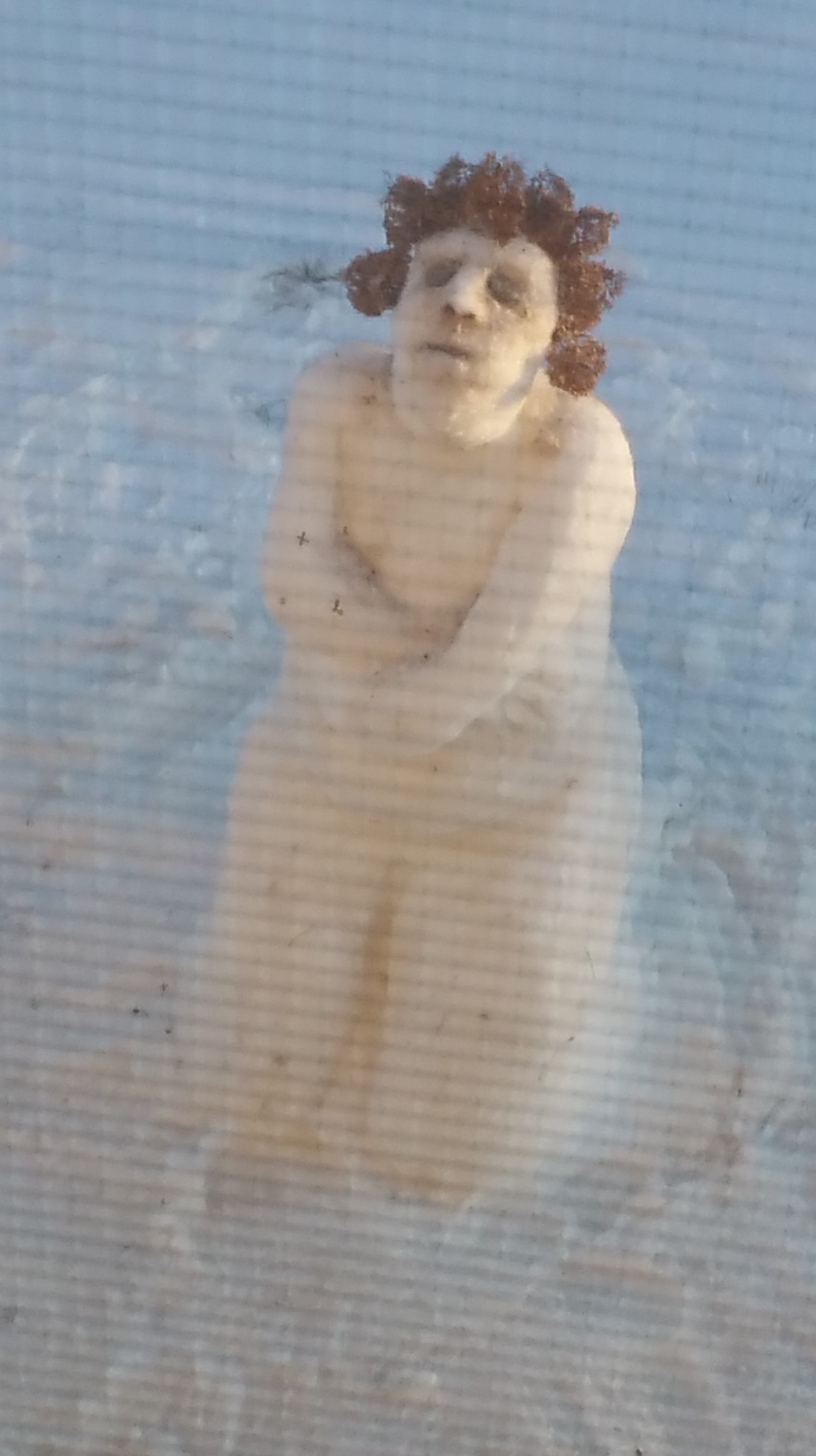
I brought over a lawn chair for my visiting snowman to relax on, and thanks to Google voice recognition translator, I was able to decode most of what the snowman was trying to say. A little snow cat had jumped up on his lap, and helped put him at ease.

20160125_155123

“You and I are very different”, he said. “I’ve come a long way and [and here he either said he was staying with his Aunt Attica or he had come from Antarctica – it didn’t help that he talked extremely slow and soft and mumbled half the time]… I’m shivering not because I’m cold, but because I am afraid.” When I nodded sympathetically, he continued, “I shiver when I feel warmth, because I know I’ll start to melt. Melting is not painful, just one never knows when they will appear again, and in what form. My girlfriend from last year might have reappeared this winter as this little cat here – one never knows.”

20160125_155134

He went on, “I feel fortunate that I’ve come back in a similar shape as last year, and that I’ve arrived in a yard where people respect me, and don’t just wrap a silly striped scarf around my neck and forget about me.” [here I cringed, because in the past I’ve been guilty of same.]

As this little conversation took several hours to complete, and the sun was starting to take it’s toll on him – I might have thought that it was my imagination if I hadn’t had my Google translator handy – we both called it a day.

20160125_155150

“But we both like cats,” he managed to say as I was walking away…


He’s back – the itinerant snowman

I saw him apparently looking up to my bedroom window.

snowman-2016

What could he possibly want? I set him up with a nice snow woman last year and they seemed made for each other (see last year’s post “This Really Happened”). Where is she now? What happened?


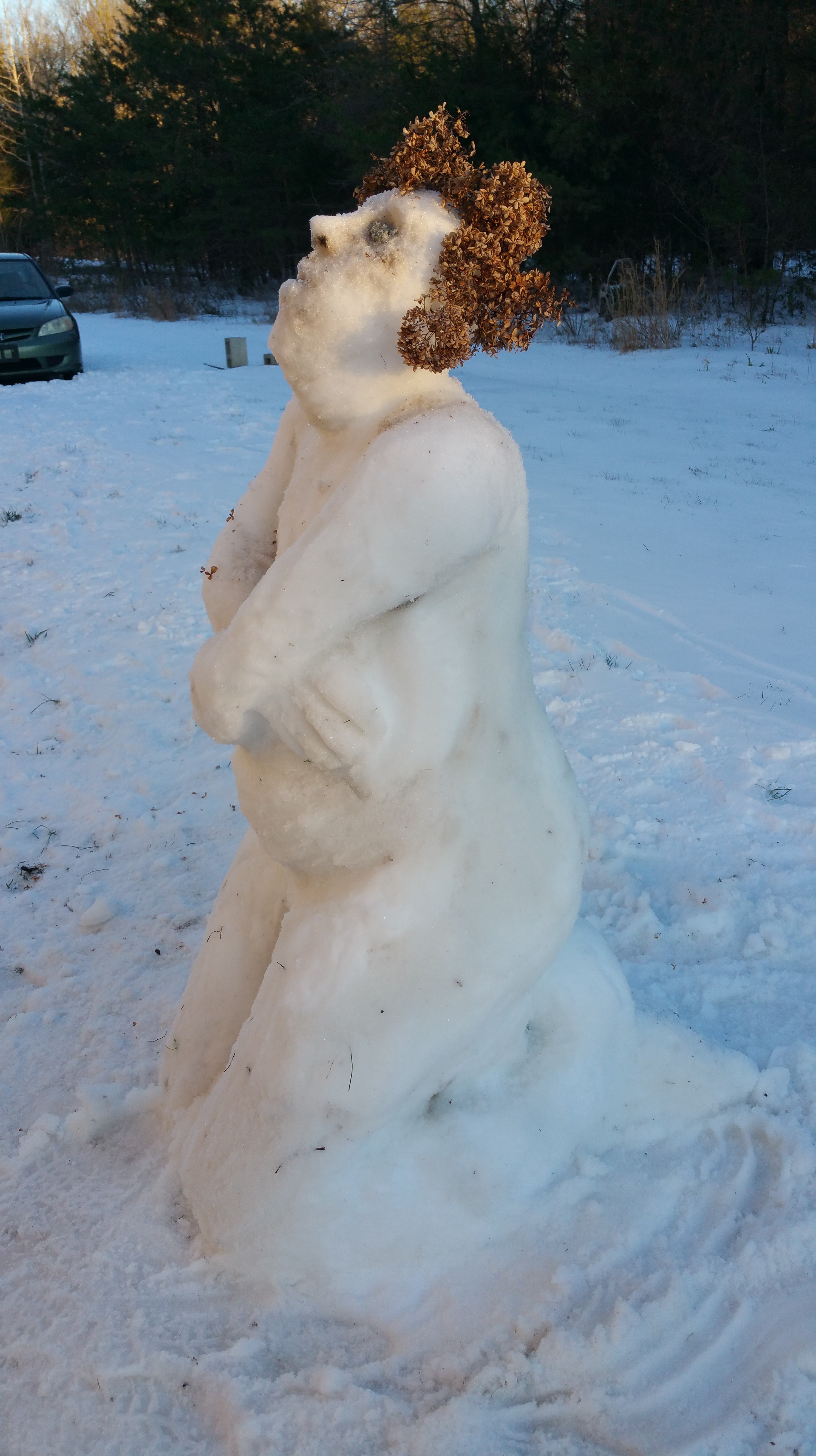
He is so obviously sensitive to the cold. Look at him, shivering out there alone. Perhaps it’s an existential, rather than physical, cold he suffers from. At any rate, I think I’ll go out there and throw a coat over him and see if I can communicate with him.

snowman-side 2016

Hmmm. He wouldn’t look at me or talk to me or even acknowledge my existence. He just keeps staring at the sky. Bird watching? Or maybe he has an eye on that windvane on my house.

We’ll see what tomorrow may bring. In the meantime, I’ll practice up on my snow dialect and learn the whispers and subtle tinklings that characterize his language, and maybe we can at least exchange basic pleasantries while he is around… (to be continued).


What to Draw: Lesson 2: Set your intention

Putting marks down on a piece of clean white paper can be a scary thing at first, so you might pick a piece of lined notebook paper, or a piece of a brown paper bag, or a napkin with coffee rings on it, to start. It can be like finding your way blindfolded through a maze – exhilarating for some; inhibiting, frustrating and even frightening for others. So let me suggest some guidelines:

More warmup exercises

When you really get into a drawing, your breathing deepens, and you feel enclosed in a safe, warm bubble, no matter where you are. Yes, go ahead and say it, mindfulness. Yep. Whatever.

Some suggestions once you’ve warmed up with a few loop-de-loops:

  • Let your hand move like the divining piece on an Ouija board, allowing the pencil or pen to move where it may.
  • Trace a photo. (Check into copyright restrictions if you want to publish your drawing, but it’s okay for practice).
  • Do a contour drawing. Don’t take your eyes off the model while your pencil moves along the outlines. Look down only when you are finished and see a fabulously distorted picture!
  • Experiment with pressure – draw fat and thin lines.
  • Smudge pencil lines with your finger.
  • Tear up your drawing, then use glue stick to paste down the pieces in different ways on another piece of paper.
  • Try something else that you think of.

Set your intention

Let me just say that it is perfectly okay to continue to draw the way you draw right now. What makes you unhappy about the way you draw? Plenty of artists who draw people with large heads and small bodies are quite successful. Do you wish your drawing was more representational, or do you wish to tell a story with your drawings? Do you want to please people with drawings that are framed gifts? Important to identify your intentions, but also know that you can enjoy drawing for the meditative act itself, and that it need not represent (be a symbol for) anything at all. Try setting your intention to “discovery”, and see where it takes you.

What to draw: Lesson 1: Loop-de-loops

spring loops.jpeg

Often upon finding out that I am an artist, someone will say to me in an ingratiating tone, “I wish I knew how to draw”. This always has had a kind of false ring to me, because if they wanted to draw, why aren’t they drawing, or at least compulsively doodling? Drawing requires doing, and really, it’s not doing much compared to other forms of artistic exertion. All one needs is a pencil and the back of an envelope to get started. So what prevents people from drawing?

Here are my guesses as to why people don’t draw:

  • They think they have to make a masterwork the first time they draw.
  • They are afraid people will laugh at them.
  • They have to clean the house first.
  • They are busy making piles of money doing something else.
  • They really DON’T wish they knew how to draw.
  • They don’t know WHAT to draw.

Why drawing is good for you. Drawing connects your brain to your body. It’s a way of making your own personal discoveries about your world, and every time you make one of those discoveries, your brain gives your body permission to feel good.

The biggest problem I’ve seen beginning artists struggle with is not HOW to draw, as WHAT to draw. They will pick something unbelievably complicated, like a lawnmower, and can’t get past the oil cap, or try to draw a face without first imagining the feeling behind the skin and bone, or draw a cat and try to keep everything perfectly symmetrical. And this causes people to throw up their hands when they are about a minute into it and exclaim, “I can’t draw!”

loopy Ls.jpeg

Start by drawing loop-de-loops. I hear that cursive handwriting is no longer taught in schools. This is a shame, because the fundamentals of handwriting can be applied to drawing. When I learned how to make cursive letters, I was first taught just to practice loop-de-loops. This is a VERY GOOD THING, loop-de-loops, and everyone who aspires to draw should practice them. Big loops, little loops. This liberating exercise is very helpful in relaxing tension and connecting your hand with your brain.

Please tell me – what are YOUR excuses for not drawing?

Next installment of this thread will be “What to draw: Lesson 2: Set your intention”.

WA-hand-script.jpeg

Where do they all come from?

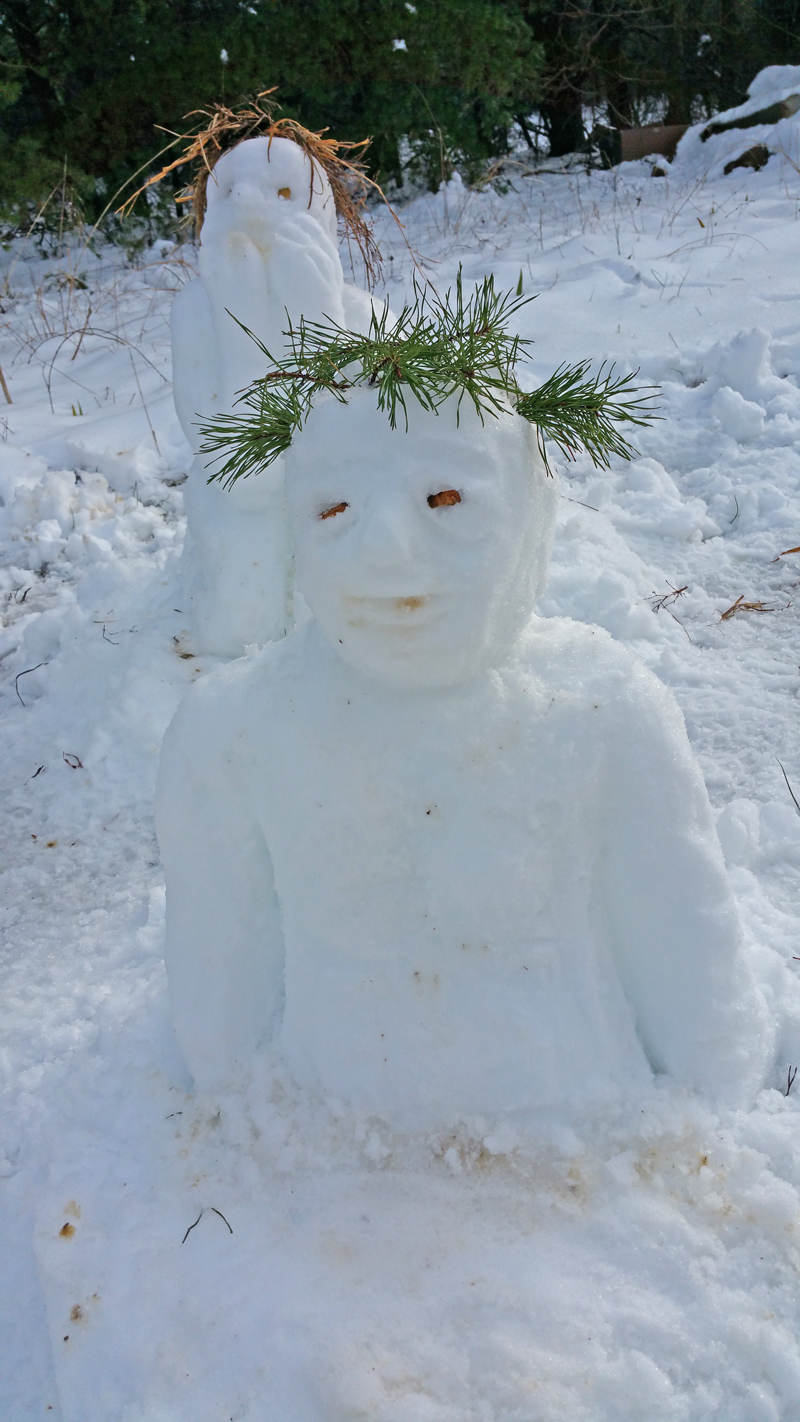
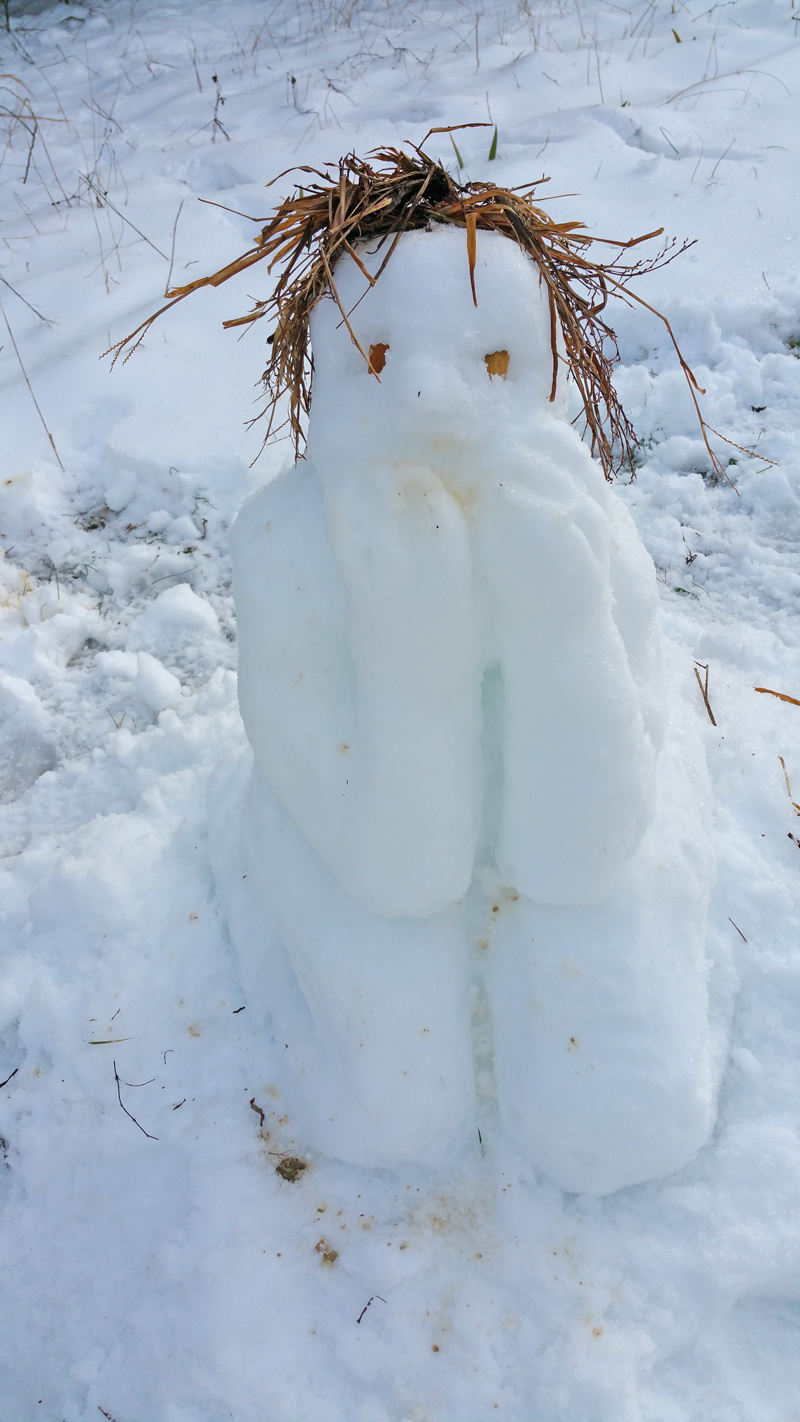
Ever since I published that post the other day about the romance between two snow people in my yard, snow people have been springing up everywhere around my house! I don’t know what they want. Maybe my yard has become a dating mecca for snow singles, or maybe they just want their pictures in my blog. Maybe they are just starved for attention. They’ll be gone when it warms up later today – I hope.

They're everywhere.
They’re everywhere now.

Snowperson-pineneedlehair Grasshaired-snowperson Snowperson-stick